
What Are Core Web Vitals?
Google’s Three Measurements Of Whether Your Site Actually Feels Good To Use
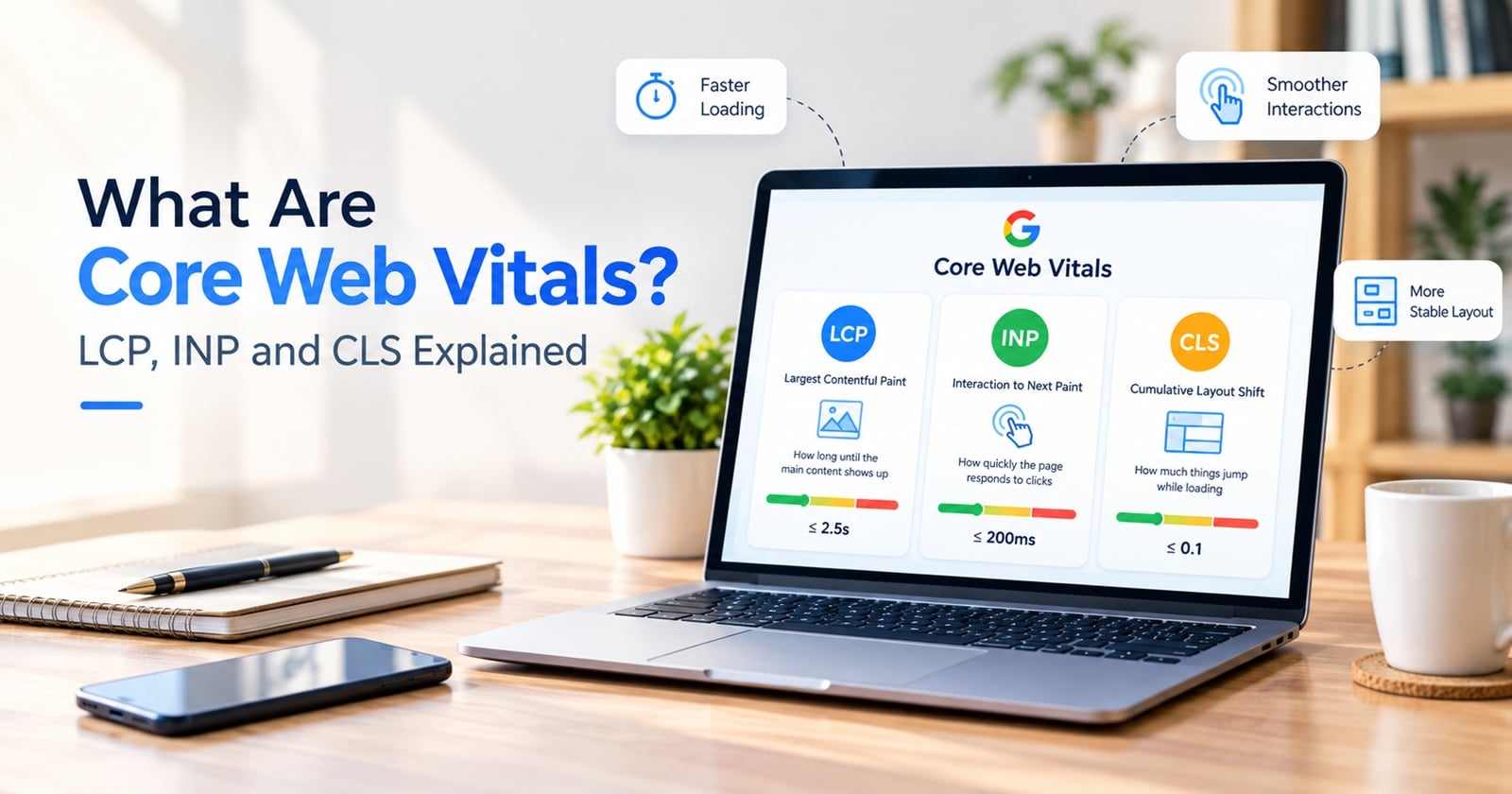
Most explanations of Core Web Vitals open with a wall of acronyms and lose the reader by the third sentence. The idea behind them is actually simple: Google measures three things about how your page feels to a real visitor, and those measurements feed into how your page ranks.
This guide breaks down each one in normal language, tells you the numbers to aim for, and explains what to do when a page fails.
What Are Core Web Vitals, Simply Put?
Core Web Vitals are three measurements Google uses to judge how quickly a page appears, how fast it responds to clicks, and how stable it stays while loading.
The three are:
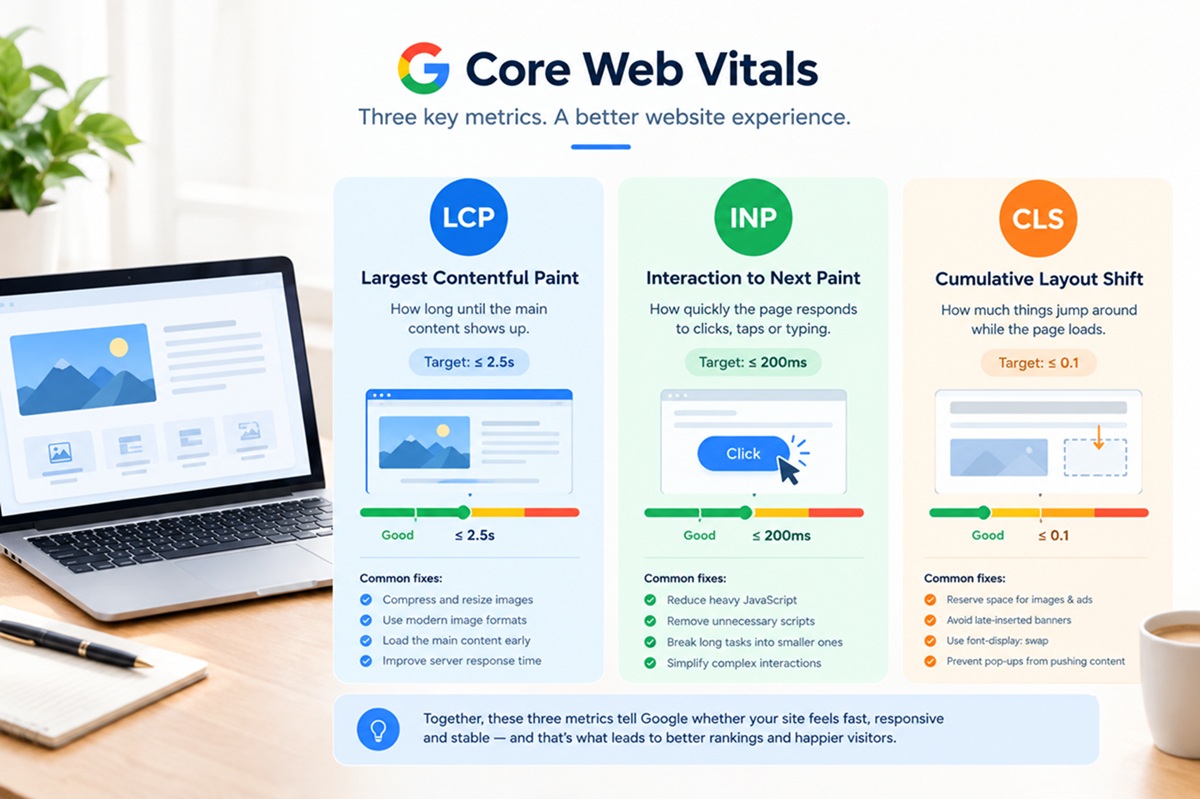
• Largest Contentful Paint (LCP): how long until the main content shows up
• Interaction to Next Paint (INP): how quickly the page reacts when someone taps or clicks
• Cumulative Layout Shift (CLS): how much things jump around while the page loads
What makes these different from older speed tests is that Google measures them using real visits from real people, not a test run from a fast office computer. As of 2026, Google’s targets are LCP at or under 2.5 seconds, INP at or under 200 milliseconds, and CLS at or under 0.1, each measured at the 75th percentile of real visits. In plain terms, three out of four of your visitors need a good experience for the page to pass.
What Does LCP Measure And How Do You Improve It?
LCP measures how long it takes for the biggest visible piece of content, usually a main image or headline block, to appear on screen.
This is the closest thing to “how fast does this page feel.” Common causes of a poor score:
• A large, uncompressed hero image at the top of the page
• Slow server response before the page even starts loading
• Fonts or scripts that block the content from appearing
• Images loaded only after other code has finished running
The fixes are usually practical rather than complicated:
• Compress and properly size the main image on each page
• Use modern image formats that are smaller without looking worse
• Make sure the main image loads early rather than being delayed
• Improve server response time, often by upgrading hosting or adding caching
For most sites, LCP is the metric with the biggest commercial impact, since it directly affects whether people wait or leave.
What Does INP Measure, And Why Is It Harder To Pass?
INP measures how quickly your page responds visually after someone taps, clicks, or types, across the whole visit rather than just the first interaction.
This is the newest of the three. INP replaced the older First Input Delay metric in March 2024, and Chrome fully retired that older metric later the same year. The older metric only looked at the very first interaction, while INP looks at responsiveness throughout the session, which makes it considerably harder to pass.
Typical causes of poor INP:
• Heavy JavaScript running while the visitor is trying to interact
• Too many third-party scripts competing for the browser’s attention
• Complicated menus, filters, or sliders that take time to respond
• Large amounts of code running on every single click
The usual fixes involve shipping less code, breaking long-running tasks into smaller pieces, and removing scripts that are not earning their place. This is the metric most likely to need developer involvement.
What Does CLS Measure And Why Does It Frustrate Visitors?
CLS measures how much content unexpectedly moves around while a page is loading, which is the reason you sometimes tap the wrong button.
Everyone has experienced this. You go to click a link, an advert loads above it, everything shifts down, and you click something else entirely. That is exactly what CLS captures.
Common causes:
• Images and videos without reserved space, so content jumps when they load
• Adverts or banners inserted after the page has started displaying
• Custom fonts that swap in and change the text size
• Pop-ups or notification bars pushing content down
The good news is that CLS is usually the easiest of the three to fix. Reserving space for images and adverts before they load solves most cases, and it is often a small change rather than a rebuild.
Why Do Core Web Vitals SEO Results Take Time To Show?
Core Web Vitals SEO results take time because Google uses real visitor data collected over a rolling period, not an instant test of your site.
This means:
• Improvements appear in your reports only after enough new visits are collected
• A rolling data window means old, slower visits still count for several weeks
• A fix deployed today may not show fully in reports for about a month
• Testing tools show improvement immediately, but reports lag behind
Many site owners panic when a fix does not show results within days and start changing things again. Patience matters here. Deploy the fix, verify it in testing tools, then wait several weeks before judging whether it worked.
Where Should Core Web Vitals Optimization Start?
Core Web Vitals optimization should start with whichever metric is furthest from passing, rather than trying to improve all three at once.
A practical order of work:
• Check your report to see which metric is actually failing, and on which pages
• Fix anything in the “poor” band first, since it does the most damage
• Prioritize templates rather than individual pages, since one fix covers many URLs
• Recheck after a few weeks of new data before moving to the next metric
• Avoid optimizing a metric that is already passing comfortably
Focusing on templates is the underrated tip here. Fixing the product page template on an online store improves thousands of pages at once, which is far better use of effort than fixing pages one at a time.
Frequently Asked Questions
Q1. Do Core Web Vitals guarantee better rankings?
No. They act as one signal among many, most useful as a tiebreaker between pages of similar quality and relevance.
Q2. Should I trust my Page Speed Insights score?
The single score is a lab estimate. The three Core Web Vitals underneath it, based on real visitor data, are what actually matter for ranking.
Q3. Are the thresholds different on mobile and desktop?
The numbers are the same, but mobile is significantly harder to pass because of slower connections and less powerful devices.
Q4. Can a small business site realistically pass all three?
Yes. Smaller sites often pass more easily than large ones, since they carry fewer scripts, adverts, and third-party tools.
Final Thought
Core Web Vitals are not really about chasing scores. They are Google’s attempt to measure whether your page feels good to use, which is something worth caring about regardless of rankings. Teams like Arihant Global usually fix the worst-performing metric at template level first, since that single change improves hundreds of pages at once. Fix the biggest problem, give the data time to catch up, then move on.